‘The painter is a medium who doesn’t realise what he is doing.
No translation can express the mystery of sensibility, a word, still unreliable, which is nevertheless the basis of painting or poetry, like a kind of alchemy’ said Marcel Duchamp¹. Jazz pianists, writers of fiction, photographers, printmakers, ceramicists — and no-doubt Joachim Froese — would likely all agree in principle. Duchamp’s words posture that the deeper meaning of art is not so much how it appeals to the eye, but an intangible, alchemical process.
In looking at Froese’s most recent suite of images titled Alchemy, I’ve been thinking about his previous photography, the longstanding work I’ve been witness to for more than two decades; what has changed, what has remained consistent, and what has led to Alchemy. Over this period Froese’s practice has encompassed an array of compelling images and concerns, and each suite of photos, despite changes in look and feel, have built on, or developed from, the previous. As he says, ‘at its core my work has always been about photography itself’. And Alchemy, emphasises this.
The photographic images of Froese’s that I first became familiar with were from an extensive series titled Rhopography (1999–2003) — large black and white, silver gelatin panels grouped in landscape format, featuring dead insects with rotting fruit and vegetables, all in sharp focus. I was immediately drawn to their close association with Baroque still-life painting. They are beautiful.
In 2006 Froese’s work shifted when his mother was diagnosed with terminal cancer, and he spent the last six weeks of her life with her in Germany, embarking on a project which included photographing her entire library of 1000 books. Ultimately the work became both a personal diary and a metaphor of a life lived. By 2008, Froese had completed this evocative series, Portrait of my mother, consisting of 93 inkjet prints, and it was shown at the Griffith University Art Museum the same year, displayed in one impressive 29 metre-long row. Portrait of my mother was closely followed by other suites about his family histories: written in the past (2007), Archive (2008), and Tell him it is all a transition (2011–14).
In 2014 Froese again took another path. Triggered by a PhD he undertook at RMIT University, Melbourne, he began to concentrate on environmental concerns, themes that were evident in his earlier Rhopography series. Simultaneously, a rising interest in historical printing techniques led him to explore salt paper printing, one of the oldest photographic processes, refined by Henry Fox Talbot in 1839. Merging the past and present of photography he now uses a hybrid process that combines this 19th century technique with digital capture, allowing him to explore entirely new conceptual pathways.
The first of Froese’s salt prints I saw was a series titled Entangled (2014) which reflected the interwoven histories of botany and photography. The photographs depicted plant seedlings (which he raised specifically for this project) showing the moment when a seed’s dormant energy turns into new growth — forceful and exposed at the same time.
Froese notes that the use of these historical processes — incorporating common ingredients such as salt, vinegar, tea, and bee’s wax — has turned his studio into an alchemist’s laboratory. With Turned Towards the Firmament (2023), a series of unfixed, non-permanent salt prints depicting the surface of Mars, he went further back in history and embraced the medium’s very origins before fixer was available — reminding us that photography’s identity has always been associated with the fleeting, the ephemeral.
With these thoughts you can see the logical link to Froese’s most recent salt print exploration, Alchemy, where he returns to fixed and permanent images. Froese, however, relates some variances: ‘What is different with Alchemy is that I didn’t have one clear concept from the start. It rather brings meditations about art, nature and science together.’ As it happens, these three areas underpinned the beliefs of the early Alchemists (12th to 17th century) until early scientists like Robert Boyle and Antoine Lavoisier marked the transition into modern chemistry — the basis for early photography.
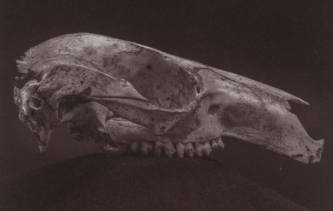
In Alchemy, some familiar themes return; flowers, dead animals and a duck decoy. At the core, however, is a collection of whole and partly broken laboratory glassware: flasks, pipettes, burettes, distillation apparatus, funnels, and more, all handmade by local glass-blower and artist Jarred Wright. While at first sight the selected objects may seem disconnected, in Froese’s mind they are closely related, and in my mind, as objects, appealing.
As in Froese’s earlier salt prints, these photographs are similarly captured with a digital camera and analogue then takes over using the salt print technique. The latter is both lengthy — to make a single salt print takes the best part of a day — and there’s always an element of fortuity with it. ‘Chance, as much as I try to eliminate it, plays a role,’ he says.
Compared to Froese’s earlier, bolder work in Rhopography, all of his salt print images, Alchemy included, are relatively small and focussed prints (20 × 25 cm each), precious images with a special beauty and warm, luminous colour. They deserve a close look. Not only has Froese’s work always been about photography itself, it has also always been associated with mindful research and a dedication to both process and delivery — and some magic.
¹ Marcel Duchamp, “The Creative Act”. From a paper given at Convention of the American Federation of the Arts, Houston, Texas, April 1957.
Ian Were writes on contemporary art, design, and associated topics.
Opening Event Friday 13 Mar 6 – 8 pm
Artist Talk with Christine Clark
Director, Curatorial & Collections Museum of Brisbane
Saturday 14 Mar 2 pm