Pat Hoffie is an Australian contemporary artist, educator and writer whose multidisciplinary practice spans more than five decades. Working across painting, printmaking, drawing, sculpture, installation and video, her work explores themes of power, identity, cultural diversity, labour and postcolonial histories.
A significant figure in Australia’s contemporary art landscape, Hoffie has exhibited extensively nationally and internationally. Her practice frequently examines social and political issues, particularly the relationships between cultural production, globalisation, human experience and the value placed on creative labour.
Alongside her artistic practice, Hoffie has made substantial contributions to arts education, critical writing, curatorial projects and cross-cultural collaboration, particularly throughout the Asia-Pacific region. Her work is represented in major public and private collections.
Exhibition Essay – Artefacts from a bigger picture
“We are bemused and crazed creatures, strangers to our true selves, to one another, and to the spiritual and material world – mad, even, from an ideal standpoint we can glimpse but not adopt. We are born into a world where alienation awaits us.” R D Laing¹
Can a print reveal a reality that cannot be seen, but can only be felt? Can a print bridge the gap between the microcosm and the macrocosm, between something that is deeply personal and intimate and something that is broadly felt and universal? Printmaking has frequently led a somewhat schizophrenic existence – it can be a most intimate and personal artform operating with a confessional diaristic intensity and an artform that is intended to enter into a political discourse and appeal to a broad public. It is an artform that possesses both an immediacy and vibrancy, as well as accommodating a distancing quality through the intervention of a mechanical instrument, like a printing press.
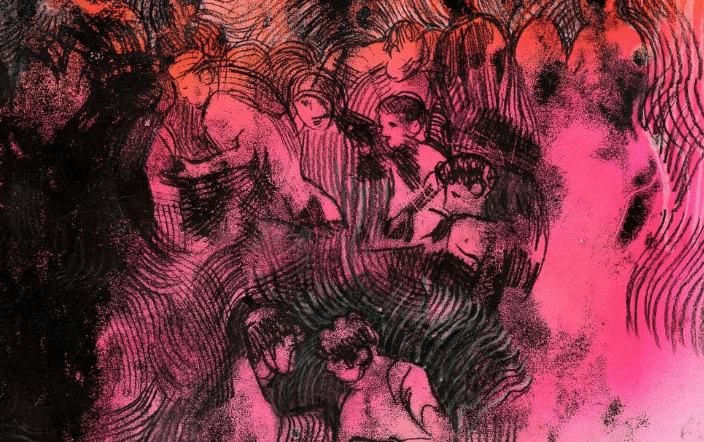
Pat Hoffie in her recent body of monotypes seeks to explore the gulf between the intimacy of human relations, the connections between people that define their humanity, and the experience of social alienation. In the summer of 1844, while living in Paris, Karl Marx for the first time formulated his theory of alienation.² Building on the traditions of the German ideas of Entfremdung (estrangement) discussed by Georg Wilhelm Friedrich Hegel and Ludwig Feuerbach, Marx moved the discussion from the abstract and the religious sphere on to a more material and economic foundation. Marx argued that people living under capitalism had become alienated from their labour and their potential to be creative, also from the product of their labour, as well as from their own humanity and from fellow human beings. People had become commodities and were evaluated exclusively through their monetary value and this fostered an atmosphere of competition and indifference rather than one empathy and of community.
Alienation has been a recurrent theme in the arts and has explored such themes as human estrangement, loneliness, disconnection from society and reality, as well as the sense of loneliness within a crowd and of people being disconnected and lacking in empathy. Hoffie appears to be particularly interested in how human groupings and environments impact on people and their interaction with other people and on the sense of empathy that they may hope to develop. These are fragments from a greater reality, pieces from a grand jigsaw puzzle that ultimately has no easy resolution. Her prints bear witness to what is happening now – observed fragments – and by shining a light on these fragments, or assembled artefacts, there is hope that a light will be cast on the bigger picture.
Hoffie in her monotypes builds up her clusters of figures, at times surging like crowds, while on other occasions, seated or moving in small groups. These are different situations where companionship and comradery are brought together and questions are asked as to what may bring us together and what may push us apart. Do some environments bind us closer together and lead to a growth in empathy, while others may add to our sense of alienation. She works with a sombre palette, favouring blacks, dark reds and pinks, where figures are not individualised but appear like the masses of humanity reminiscent of those captured in Goya’s intaglio prints in Los desastres de la Guerra. There, as in Hoffie’s prints, truth is not expressed in bright colours and shown in a heroic light, but is found in the shadows and shade and is caught within a constant state of flux.
Hoffie appears conscious of the comment made by Walter Benjamin, back in 1935, that “Humanity’s self-alienation has reached such a degree that it can experience its own destruction as an aesthetic pleasure of the first order.”³ For me, there is something apocalyptic about this body of Hoffie’s prints, a heightened emotionalism in the Crowd Crush and Crowd Surge, together with quiet reflective moments in Two Brothers and Two Girls Holding Hands. While there is much that divides us, but in Turning Back Again and Sharing a load, there is a hint at something that may lead to a unity of purpose and a development of empathy. There are bold expressive gestural marks, painterly interventions and spreading seas of murky emotive colour. All of this is played out on a modest scale, where the compositional elements are focussed and concentrated and collectively build up an intensity of a hallucination with a touch of claustrophobia. There are implied narratives in each of the monotypes, but these are never explicitly explained and invite the viewer to furnish an explanation or provide their own interpretation.
By turning to printmaking, Hoffie taps into a tradition of public art, where art is prepared to intervene into a widely accepted understanding of reality. Its purpose is to make people question the status quo, to stop, and within the created space encounter conflicting realities. When you shine a light on a world that is out of joint, people may wish to address this dilemma and seek an alternative path.
Herbert Marcuse celebrated the ability of art to challenge reality. He wrote with eloquence and conviction,
“The truth of art lies in its power to break the monopoly of established reality (i.e., of those who established it) to define what is real. In this rupture, which is the achievement of the aesthetic form, the fictitious world of art appears as true reality.”⁴
I think that the biggest achievement of this series of Hoffie’s monotypes is their ability to challenge our prevailing notions of reality and through this assembly of fragments of reality or artefacts from the bigger picture, she encourages the viewer to seek an alternative reality, one characterised by a collective empathy and of a society living together as a united community.
Sasha Grishin AM, FAHA
Footnotes
¹ R D Laing, The Politics of Experience and The Bird of Paradise, Penguin Books 1967, pp.11-12
² Karl Marx, Economic and Philosophical Manuscripts of 1844
³ Walter Benjamin, Illuminations: Essays and Reflections, edited by Hannah Arendt, translated by Harry Zohn, New York, Schocken Books, 1968, p.242
⁴ Herbert Marcuse, The Aesthetic Dimension: Toward a Critique of Marxist Aesthetics, Boston: Beacon Press, 1978/1979, p.9