
Swimming in the sea has an ecstatic aspect, communing with the sublime; swimming in a river is a more reflective, even melancholy experience. But rivers are seldom uninteresting; Mallarme said in the autobiographical note he composed for Verlaine that one could spend whole days boating on a river and never feel that time had been wasted.
This is the setting of Harding’s river pictures, as is the vast mass of the cliff faces opposite the river beach: immemorially ancient forms probably carved out in the course of millions of years by the unassuming waters flowing by.
The pairing of water and rock is ubiquitous in Chinese painting too, the eternal interaction of female and male, yin and yang in the life of nature.
All successful art requires a matching of expressive means to subject, and in this case Harding’s more recent style is well suited to what he wants to paint.
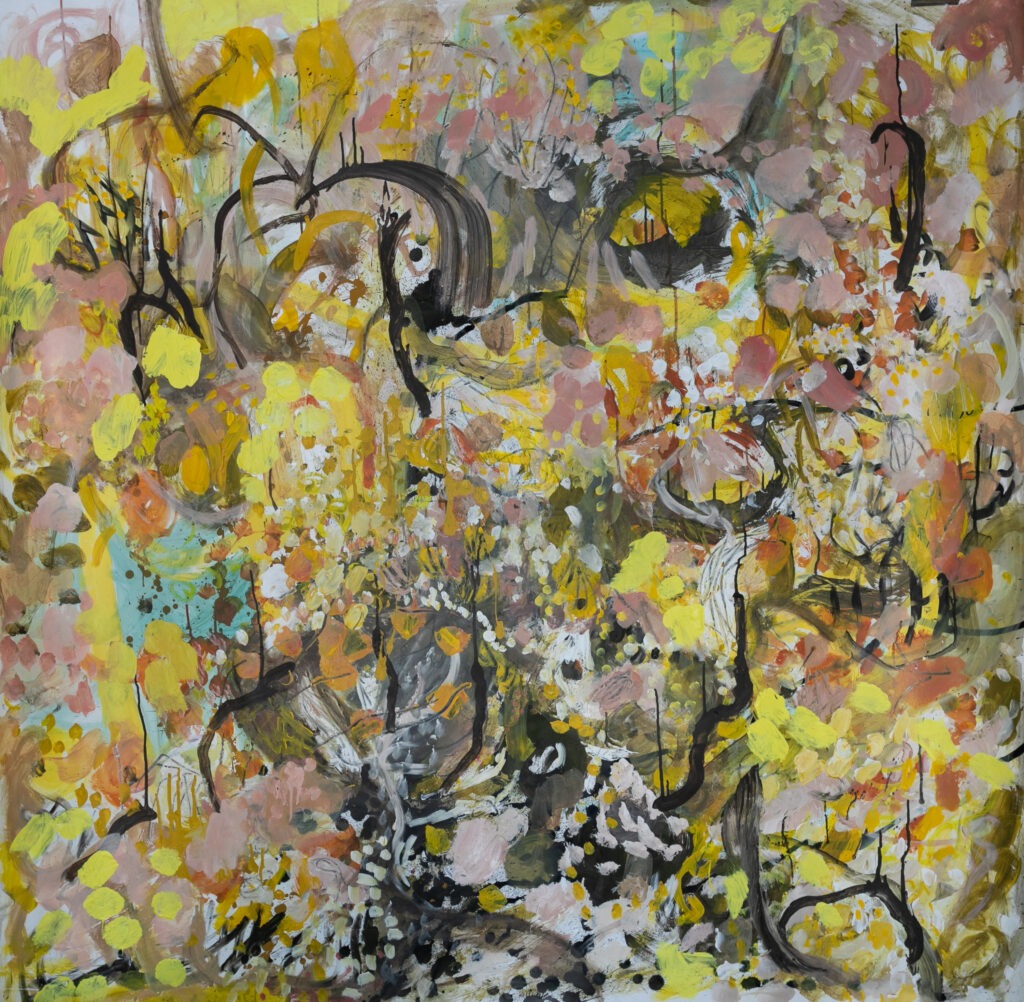
The rocky faces of the cliffs cannot be rendered literally, especially on the scale he adopts, without losing all sense of their stark grandeur; Harding’s bold and heavy strokes of paint become a pictorial equivalent of the sheer cliff faces and the heaped boulders by the shore.
It is one of those curious paradoxes of art that quick and decisive strokes are required to give an adequate account of forms that have arisen over a long period of time. As with the flowers, an intimate attunement to the nature of the subject is more important than minute imitation.
On the beach, beside the fluid impassivity of the river, his figures stand or recline. They are not doing anything, not interacting with each other. But whereas the seaside figures seem bodies empty of consciousness, here something more profound is taking place.
The atmosphere is still and silent. A woman looks over to the river; a man floats on his back under the cliff. Another wades in the water near the edge. There is a strong, in this last case almost solemn, sense of their presence in the place and in the moment.
In these pictures, painted only last year, Harding has achieved something that is very hard to do today: to paint the figure in the landscape, and thus to evoke the experience of being in nature. They are memorable images of ordinary people in unselfconscious communion with the natural environment.
Extract from “At One with Nature” by Dr Christopher Allen
Image – Nicholas Harding Estuary landscape (Figures, bags and towels) 2014. oil on linen, 138 x 138 cm.