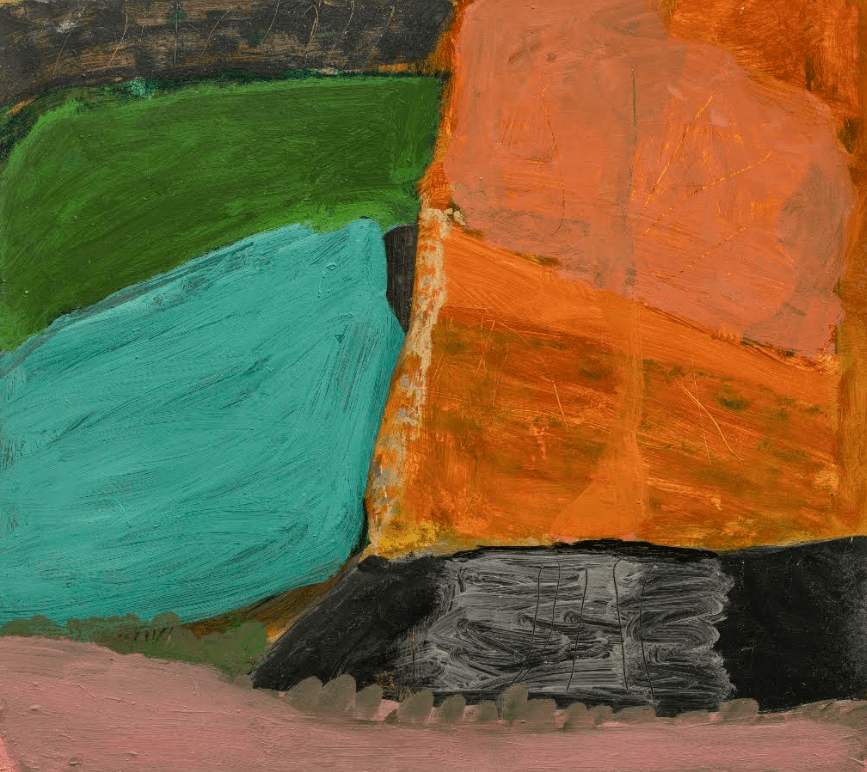
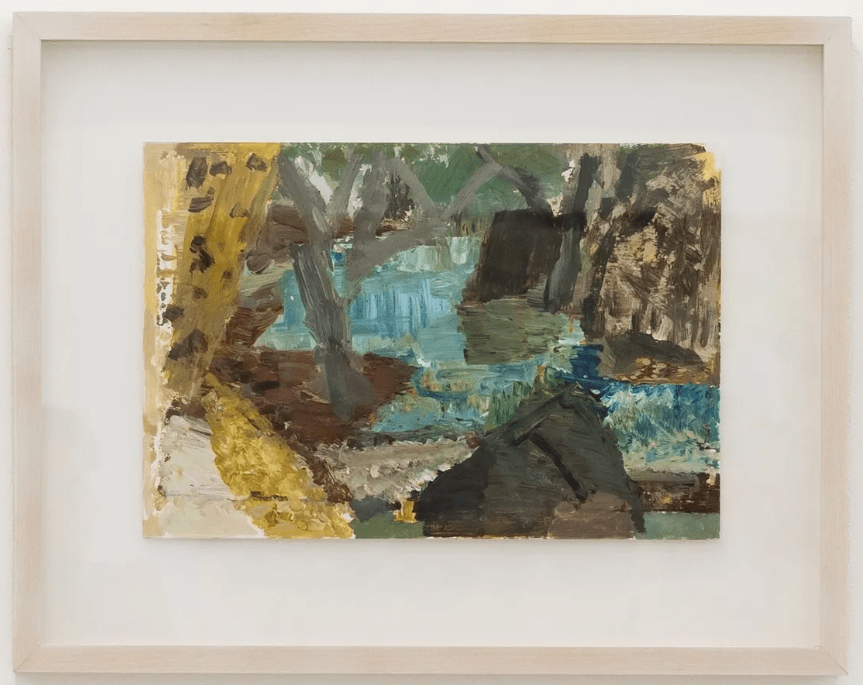
To respond intimately to a landscape is to engage in a process of sustained observation and translation. I was the River Gum and the Pond Lily brings together paintings inspired by two geographically disparate places –works made at a residency at Fowlers Gap, in the far North West of NSW, and works inspired by the temperate coastal woodland surrounding my studio in Maine.
Landscape painting can often be a way of documenting a place, however for me it has become not just a way of honoring the natural world but a departure-point for formulating a singular visual language.
In 2025 I visited Fowlers Gap and spent time making studies of the river gums along the temporal waterways and billabongs, much like many Australian painters before. It is sacred country to the Wiljali people and redolent with the spirit of their communion with their ancestors, totem animals, flora and fauna, and their dreaming stories. It has also become a place where artists return to again and again, to watch, listen and learn.
Similarly, I have been responding deeply to the lily-dappled marshes and pools surrounding my property at the foothills of Acadia National Park in Maine, the meeting place of the Wabanaki peoples, where water is abundant, offering up ambient reflections, web like tangles of birches and a rich contrasting palette. Here I tend to make en plein air watercolor notations and monoprints in order to describe the dappled rhythms and complex patterning.
Back in the studio, with physical distance from these places, the studies were used as a prompt towards a conceptual distillation, allowing memory and emotional mark-making to take precedence over representation. It struck me how a common thread began to weave its way through the works – a conversation of sorts. Perception or a way of seeing is particular and personal. I have come to believe this is the key to originality, beginning with the eye, through the heart, towards the hand and on.
As Picasso noted “It’s not what, it’s how”. These paintings are not depicting the place itself, but rather an act of translation – the cognitive bridge built between two distant places. I was the River Gum and the Pond Lily is ultimately an interrogation around perception, an assertion that the artists hand and sensibility can synthesize disparate worlds into a unified visual language – transforming reverence for the natural world into a formal celebration of paint.
– Joanna Logue, 2026
Joanna Logue is an Australian-born painter, born in the Hunter Valley, New South Wales. She holds a Bachelor of Arts in Visual Arts (1986) and a Graduate Diploma in Painting (1987) from the City Art Institute in Sydney. Raised in a rural environment, Logue developed an early connection to the landscape that would become central to her artistic practice. After establishing her career in Australia, she relocated to Mount Desert Island, Maine in 2017 where she continues to live and work. She draws inspiration from the dramatic changing of seasons seen in the landscape around her. The dramatic seasonal shifts and coastal terrain of the northeastern United States now serve as a new source of inspiration, offering a striking contrast to the light and climate of her native Australia.
Logue has exhibited widely in both solo and group exhibitions across Australia, the United States, the United Kingdom, Canada, and Hong Kong. She has been the recipient of several awards, including the Country Energy Prize for Landscape Painting (2006) and the Central West Regional Artist Award (2009), and has been a finalist in significant national prizes such as the Fleurieu Art Prize, the Paddington Landscape Painting Prize, and the NSW Parliament Plein Air Painting Prize. Logue has undertaken residencies at Hill End, Bull Bay, and through Bathurst Regional Art Gallery. Her work is held in a range of public and private collections, including Bathurst and Cowra Regional Art Galleries, Cornell University, and numerous corporate collections throughout Australia and North America.
Image: Billabong 2026, gouache on arches paper, 22 x 32.5 cm