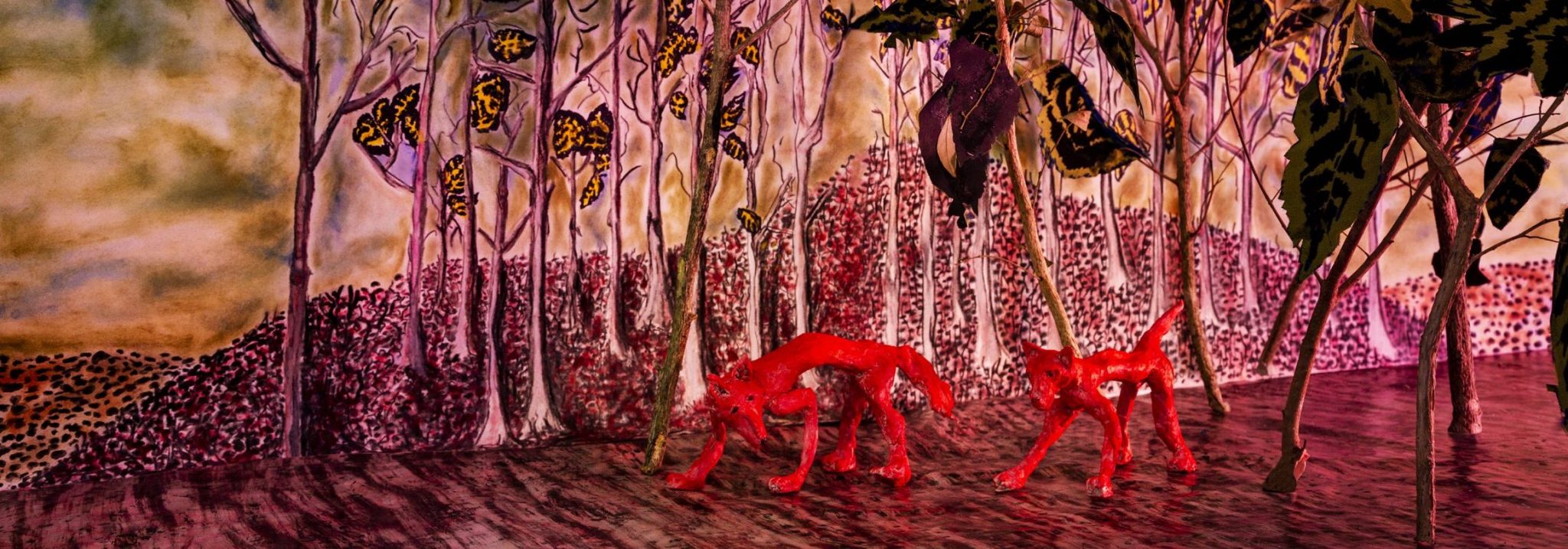
At the centre of Anna Gonzalez’s practice is the diorama. Working with fragile, hand-built materials – paper, mirrors, thread, wire, edible jelly and paint – she constructs intricate sculptural environments. The miniature worlds are later translated into large-scale archival inkjet prints. Most of the works presented in Tiny Worlds, Tall Tales are these resulting photographs, which expand delicate, temporary constructions into immersive, psychologically charged images. The photograph is not documentation but transformation, fixing scenes that never truly existed into something uncannily real.
Gonzalez develops sculptural strategies in which materials hold, withhold, and misalign meaning. Fragility is not only aesthetic but epistemic: materials limit understanding as much as they enable it. In this sense, the works teach through suspension rather than clarity.
In this slippage between fabrication and photographic authority, vision itself becomes unstable. Seeing is no longer passive reception but an active, constructed event. Throughout the exhibition, eyes recur as physical objects – held, presented, exchanged. Removed from the body, they become symbols of surveillance, memory and self-awareness. Vision becomes material, something that can be handled, offered, possessed and endured, recalling Gonzalez’s upbringing in Francoist Spain.
When the Trees Shake, the Dance Begins (2022) entices the viewer into a luminous, ritualistic environment. Beneath towering, blood-red trees, figures float, drift and dance, suspended between animation and collapse. Saturated reds engulf the scene, turning wood into something almost flesh-like: veined, wounded, alive. Animal bodies rest at the edges, poised between flight and fall. The movement of the figures is ambiguous – celebration, ritual or compulsion. The forest pulses with heat and memory. Drawing on Karen Barad’s concept of intra-action, bodies and landscape do not precede their encounter but materialise through it, co-constituting one another. Agency is therefore distributed rather than possessed.
Across the exhibition, Gonzalez constructs spaces where trauma, displacement, memory and imagination coexist without resolution. These are not illustrations of personal history but speculative re-stagings of its psychological atmosphere: instability, absurdity, vulnerability and endurance.
By invoking archetypes historically linked to female persecution – witches, dancers and spirits – Gonzalez reclaims these figures as embodiments of collective resilience and shared knowledge. The witch is no longer solitary or exiled but fundamentally entangled with the more-than-human world. The work gestures toward a politics of interdependence, resisting the romanticisation of nature and the individualisation of agency. Power circulates, resisting containment and singular ownership.
In Catching Mosquitoes (2021), fragile figures climb unstable ladders within a sparse, indefinite landscape. Their bodies appear provisional – sustained less by solidity than by relation and repetition, as if subjectivity itself were still under construction. The bleached palette does not signal incompletion but overexposure, like an image left too long in the light. Soft creams and diluted washes drain the scene of urgency. Nothing insists; nothing resolves.
Midway through the ascent, one figure pauses, distracted by an insect. This slight gesture unsettles the expected narrative of labour. The body leans, hesitates and reaches with curiosity. Red forms puncture the desaturated field. Hovering between fruit, wound and signal, they draw the eye without yielding explanation. Meaning remains suspended, echoing the unstable terrain of memory itself.
Works such as The Bridge (2020) condense complex emotional states into deceptively simple scenarios. A fragile rope bridge stretches across a darkened space. One figure stands suspended at its centre, caught between steps, while another falls beneath it, arrested mid-descent. A small suitcase lies abandoned, a quiet symbol of departure, migration, expectation and the illusion of preparedness. Behind the figures, swirling, hand-drawn patterns collapse sky, ground and wall into a single restless surface.
Across Gonzalez’s practice, humour operates as a critical strategy rather than decoration. Her figures appear fragile, awkward or absurd, their exaggerated gestures exposing vulnerability while simultaneously resisting victimhood. This humour, inherited through personal and cultural histories, becomes a mechanism of survival – a way to confront violence, displacement and emotional rupture without becoming consumed by them.
The bridge is a material metaphor for what Gloria Anzaldúa names in Borderlands/La Frontera: the psychic and embodied condition of living in nepantla – the in-between space where old narratives no longer hold and new ones have not yet formed. Nepantla is not comfort; it is rupture. It is the disorientation of standing on a structure that sways.
With We Are Not Alone (2026), Merveille Maison (2022), and The House of Cats (2025), the exhibition shifts register. Resembling dollhouses, the dioramas are no longer mediated by the camera; they stand before us. The mechanics of staging are exposed. Fully realised interiors hold surreal puppets, handmade furnishings and borrowed objects, each house lit like a miniature stage set. In The House of Cats (2025), a handwritten poem inscribes the artist’s voice directly onto the wall.
This opening extends into the children’s area, where Gonzalez introduces participation into the exhibition’s logic. A large-scale diorama invites visitors to create paper puppets and place them within the scene. Authorship loosens. The miniature world becomes porous and collective.
What emerges is not an educational supplement but an ethical extension of the practice. By handing the stage to children, Gonzalez shifts the work from preservation to transmission. Memory is not resolved or sealed; it is rehearsed, altered and kept alive through play. The exhibition closes not with a fixed image, but with a living system – one that sustains unresolved tension, suspension and non-arrival as forms of knowledge in themselves.
Written by Crisia Constantine