What occurs when Brisbane’s most prestigious art gallery opens its doors after hours – and what does it reveal about how spaces could create a better world?
The museum becomes a dream machine. An experimental playground formed through the ultimate shared participation of art – the public unconsciousness dares to imagine living in a better world.
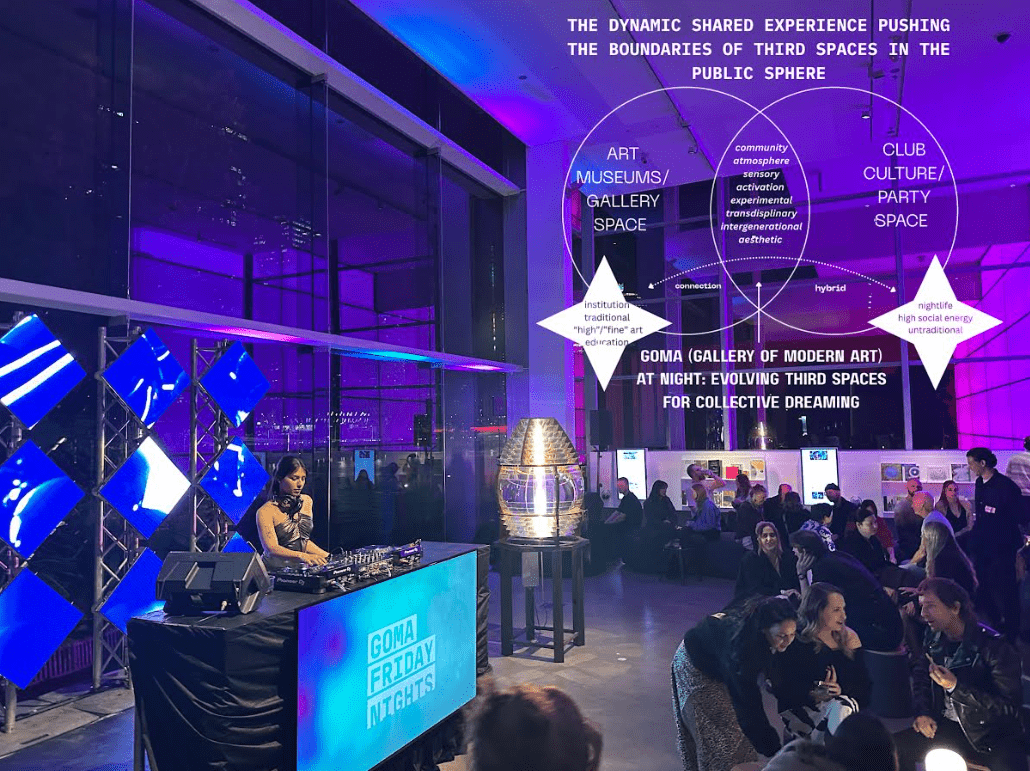
GOMA has invited us for a Friday night out – a hybrid event with vinyl-listening rooms, DJs, live experimental performance, bar and speakeasy – taking place during ‘Olafur Eliasson: Presence’, a multi-sensory immersion experimenting with light, colour, perception and humanism.
I attended GOMA’s second ever night out on May 8th, and was delightfully surprised by the transformational sense of community being built within the space; with multimodal activities taking over the entire ground level, and was reminded of how essential pushing the boundaries of Space is.
Eliasson’s Presence already is extremely immersive, interactive installation on the shared human experience — GOMA’s activation of the space through DJ’s, food and drink, performance and a nightlife setting created a space genuinely dynamic and hopeful – decoupling art participation from hostile architecture – inviting bodies to move, freedom to talk, play, imagine.
A staff member at QAGOMA put it to me simply:
“GOMA at night, people are more engaged in the art and in interacting with each other. Everyone’s much more friendly, and people are excited to experience it. People are more intentional – when they come tonight they are intentionally coming to see art.”
“Third Spaces” describes the informal public realm that exists between the first space of home and the second space of work or school – the cafe, the park, the library – where class hierarchies are dissolved through accessibility and temporary communities are formed in fluid social life. Most Australian formal museums are second spaces wearing the costume of third spaces: controlling behaviour, institutionalised, quietly intimidating – accessible in theory but exclusive in practice.
GOMA nights don’t just challenge this pretentious attitude. The space actively dismantles it.
One young attendee described the experience to me with refreshing authenticity:
”It’s like a house party.
Every room (in the museum) feels like a different room in someone’s house.”
The sheer intimacy of a ‘house party’ analogy within a huge, structured installation demonstrated to me the ambitious potential for museums: to blur the boundary between art and life, where there is an open invitation to genuinely connect with creativity and community through self-directed paths.
Museums serve as vessels for collective dreaming – where shared experiences improve and impacts the collective public unconsciousness. Simply through sharing space, and expressing joy together, the public unconscious shifts: How do we rebuild our world to grow more opportunities for love, art, play and interaction within the public sphere?
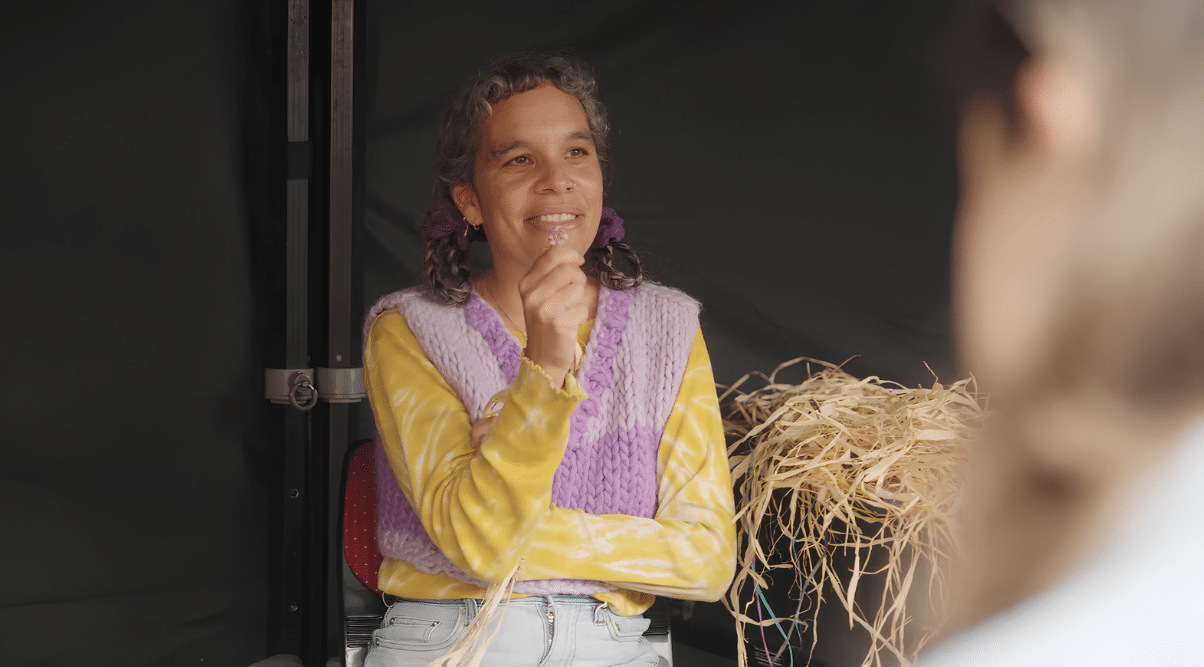
WHAT DOES LIGHT AND DREAMING SOUND LIKE? – An interview with Karishma, local Magandjin artist and a curated disc-jockey for GOMA Night, written by Tasmiya.
The essential element in the activation of GOMA’s museum to become a dynamic playground nightlife – most likely to go unacknowledged in a traditional review – the DJ set.
Karishma, a Brisbane-based multidisciplinary artist and DJ, situated her live set in the ‘River Room” communal space adjacent to the exhibition – the sculpture Your Lost Lighthouse (2020), a colourful SOS signal flickering in light beside the decks.
Her presence quite literally elevated Presence into an innovative experiment in the collective experience. The addition of a DJ complimented Eliasson’s exploration into rainbow and light, whilst being set on a Friday night, created unmistakable parallels with underground club/rave aesthetics and visuals.
Karishma told me she walked through the exhibition before selecting her tracks:
“I consciously made my set super ambient, dreamscape-y, cosmic, very ethereal, to make sure that if someone was to look at a light display they could really take it in.”
The result was an atmosphere I can only describe as contemporary meditation.
Tasmiya: “HAVE YOU EVER DJ-ED INSIDE AN ART MUSEUM BEFORE?”
Karishma: No, it is my first time!
Tasmiya: “WHAT WERE YOUR THOUGHTS?”
Karishma: I was really nervous! I don’t know what the crowd is going to be like– you know its quite commercial – like it’s Gallery of Modern Art Brisbane. Meanjin. That’s huge, that’s a huge thing.
The art world carries connotations of class and cultural gatekeeping, whilst nightlife and DJ-culture has its own stigma. To merge those two modes into one creates the revolutionary intersection for evolving third spaces.
“People associate DJ-ing with The Club, Partying… its nice to be able to show off music that is not necessarily “boom boom boom” clubb-y.
Its unique music, you would not hear this on the radio. You wouldn’t hear it any mainstream clubs in the Fortitude Valley.
To find the equilibrium of those two very different spaces — (THE ART MUSEUM AND THE CLUB SPACE) — is a rarity.” In the final room: “Urgency and Creativity”, The glacier melt series 1999/2019 & Model for your circular city (2024), I could hear Karishma’s set bleeding in from the outside. This was key for transforming how the audience not only engaged with art, but decorated the entire atmosphere, to invite conversation and active reflection.
“Usually you go to the museum, you exit the gallery, its quiet and then you go home,” she reflected. “Instead you walk out and hear something beautiful.”
During her set, within that shared space, it was the loudest I had ever heard people allowing themselves to be in an art museum. I could see people breaking from their acceptability composure to moving their bodies with more freedom and autonomy within public space. I could see clearly how coexisting together with expression of creativity and joy radically expands the potential for what life could be like.
Written by Tasmiya Ahammad